
About Me
Kenrick is a PhD researcher at the Institute of Statistics, Biostatistics, and Actuarial Sciences in Université catholique de Louvain under the supervision of Karim Barigou. His research focuses on integrating climate risks into actuarial and financial risk modeling. He develops quantitative models that integrate climatic variables to study their impact on mortality dynamics and to assess implications for forecasting, pricing, and hedging in insurance and financial markets.
Kenrick holds a master’s degree in applied mathematics with a major in mathematical finance from Ateneo de Manila University. His background includes quantitative risk management, stochastic modeling, and developing mathematical tools to address uncertainty in finance and insurance. He is particularly interested in applying neural networks to forecasting, pricing, and hedging problems.
Building on this foundation, he has become increasingly focused on the challenges posed by climate risks to the financial sector. Understanding and managing climate risks is becoming more important as environmental changes bring new and unpredictable challenges to financial security. Kenrick’s work aims to translate mathematical models into practical tools that help insurers prepare for climate risks, with the goal of contributing to a more resilient and equitable financial system.
My Research
[Preprint]
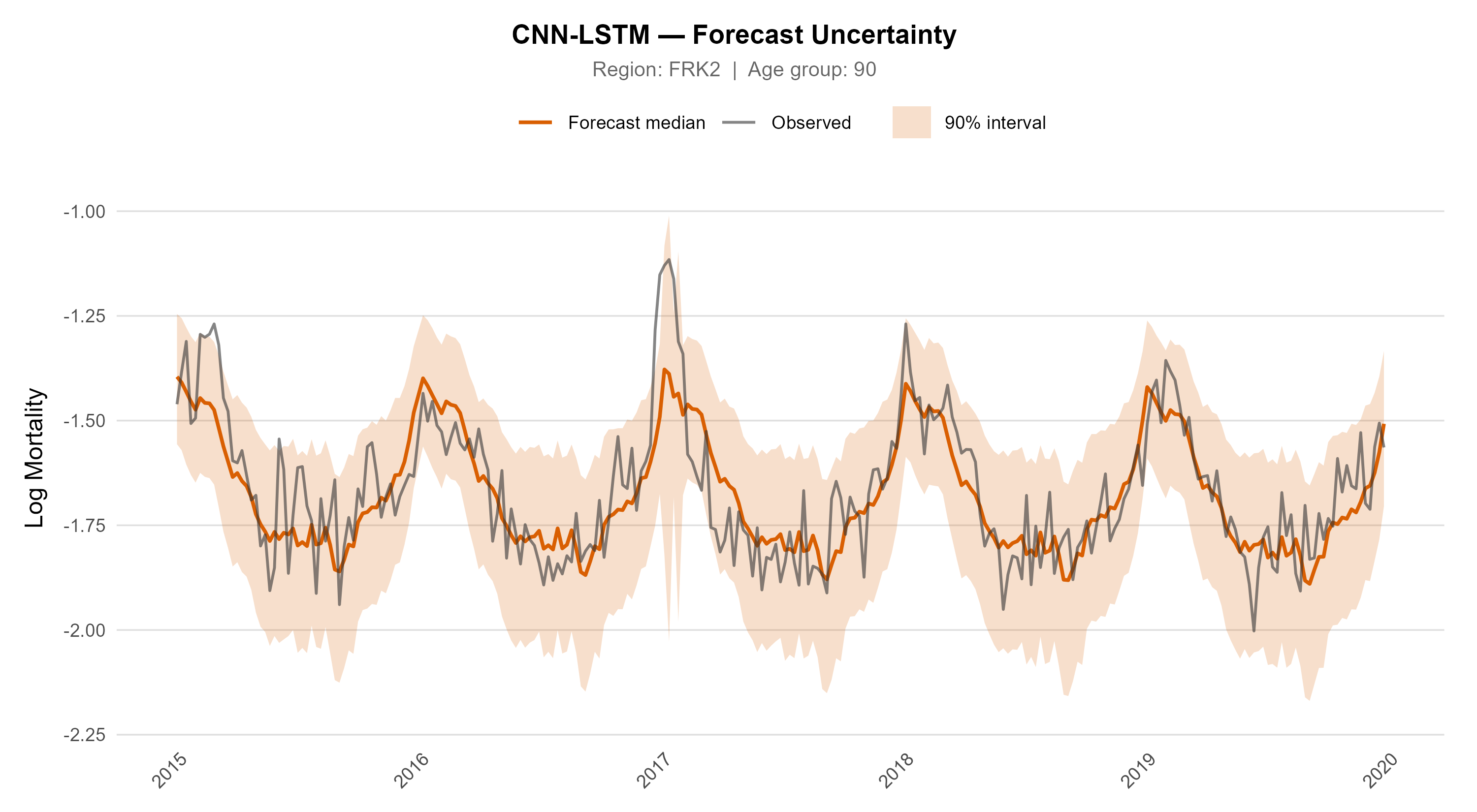
Climate extremes have become important drivers of mortality, producing sudden spikes that traditional models fail to predict. We propose a two-step framework combining a regional weekly Lee–Carter baseline capturing long-term trends and seasonality with two deep learning models for excess mortality driven by environmental conditions and climate shocks: a CNN–LSTM that captures temporal responses via convolutional filters and a GNN–LSTM that uses graph-based structure to model spatial dependencies and propagation of climate impacts across regions. Both are extended with a quantile LSTM to produce time-varying prediction intervals. Using French regional data from 1990–2019, we compare against the Lee–Carter baseline and MortFCNet, finding that both models capture delayed and nonlinear effects of environmental extremes and consistently outperform benchmarks, reducing test MSE by about 24% relative to MortFCNet, with larger gains at older ages where climate-driven spikes are strongest, while also providing more informative risk estimates for insurers and pension funds.
Risks, vol. 13, no. 2, 2025.
[Read here]
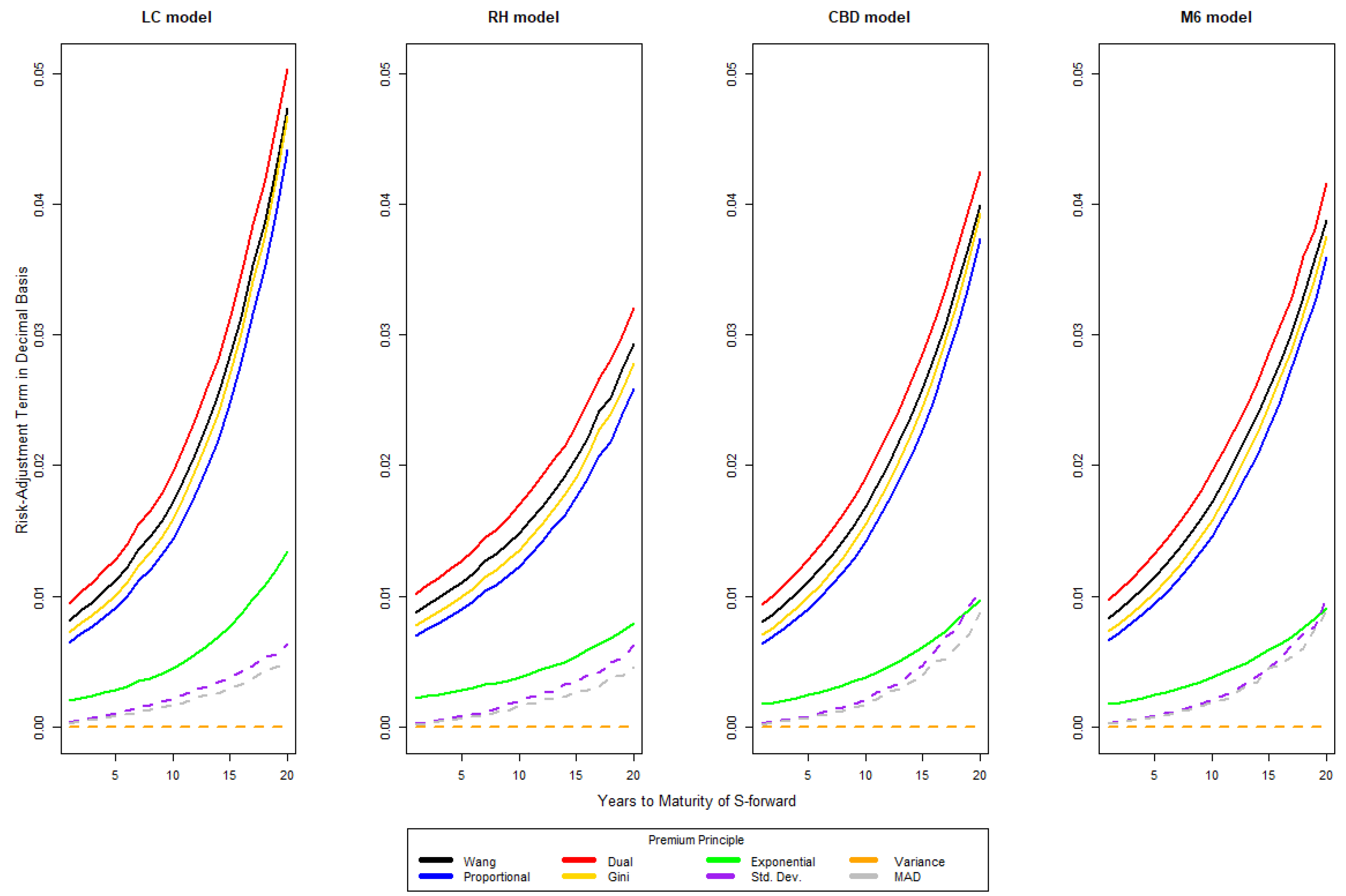
As life expectancy rises, pension plans face increasing longevity risk. Survivor contracts, a type of longevity-linked security, allow these plans to transfer risk to capital markets. However, there is still debate over the best mortality models and premium principles for pricing these contracts. This paper examines how different modeling choices affect the pricing and risk measurement of survivor contracts. We present a framework for evaluating risk using various mortality models and premium principles, and analyze their impact on key risk measures such as value-at-risk and expected shortfall. Our findings highlight the importance of refining both mortality models and premium principles to improve pricing accuracy and risk management. We also recommend that practitioners use expected shortfall alongside value-at-risk to better capture tail risks and guide capital allocation.